
| 604 Hits


eames_storage_unit_300.jpg


 The concept of "modularity" wasn't in the popular lexicon when Charles and Ray Eames designed their innovative Storage Units (1950) that can be configured to fit a space or need. Suitable for office and residential use, these units were designed as storage and display spaces, with two color schemes. The design resulted from work the Eameses did for a 1949 exhibition at the Detroit Institute of Arts, and the molded plywood and wire supports echo other items designed by the Eameses, such as their wire base tables and chairs. The "multi" color scheme includes birch fronts and a blue side panel. The "natural" color scheme includes birch fronts and a tan side panel. The shelves in both color schemes are black. The nylon glides are easy on floors.


Materials:

Zinc-coated steel supports and perforated panels; nylon foot glides; dimpled plywood cabinet fronts; molded plywood drawer fronts and shelves; painted hardboard case sides and back panels. 


Eames Storage Unit - 1x1
Dimensions:
H 20.5" W 24.5" D 16"
 
Eames Storage Unit - 1x2
Dimensions:
H 20.5" W 47" D 16"
 
Eames Storage Unit - 2x2
Dimensions:
H 32.5" W 47" D 16"
 
Eames Storage Unit - 4x2
Dimensions:
H 58.5" W 47.5" D 16"


eames_storage_600.jpg


 image credit:  Narisa


 A product introduced before its time, the Eames Desk Unit is emblematic of the grace and vision Charles and Ray Eames used in solving home furnishing problems.

A result of work they had done for a 1949 exhibition at the Detroit Institute of Arts, Eames Desk Units and Storage Units reveal the "machine aesthetic" and Japanese influences important to the Eameses at the time. Long before "modularity" and "high tech" entered the language, Charles and Ray combined standardized parts in many ways to create practical furnishings that suit a variety of uses at home and the office.

The wire cross supports used in Eames Desk Units echo other classic Eames designs, including Eames Storage Units, wire chairs, and wire-base tables.


 Dimensions:

 H 29" W 60" D 28"

Materials:

Plywood; painted hardboard sides and panels; zinc-coated steel; nylon glides.


eames_desk_unit_600.jpg

| 367 Hits


eames_coffee_table_300.jpg


                                                                                                                                    image credit: Đ


This classic table's top and legs are shaped by molding thin wood veneers under heat and pressure--the same breakthrough process Charles and Ray Eames used to create their molded plywood chairs.

The coffee table first came to Herman Miller's attention when George Nelson, design director, saw it and other Eames molded plywood products at a showing in the Barclay Hotel in New York City in the mid-1940s. Nelson contacted the Eameses and soon afterward, they were designing for Herman Miller. These imaginative tables are an enduring landmark of modern, functional design.


Using the same technology that led to the invention of their iconic molded plywood lounge chairs, the Eameses designed their Plywood Coffee Table (1946) to have a lean, shaped form that was durable yet lightweight. Its "saucer"-like top and curved legs first caught the eye of Herman Miller; design director George Nelson during a one-man furniture exhibition at the MoMA in 1946. Herman Miller has been faithfully manufacturing the table for over 50 years. Compact and lightly scaled, it is a versatile coffee table for both traditional and modern spaces. Able to single-handedly convey the spirit of Eames design with its warm, molded plywood and personable shape, it is further complemented by the Eames; Molded Plywood Lounge Chairs. Made in U.S.A. Simple assembly is required.


Dimensions:
H 15.5" Diameter 34"
Materials:
Natural ash veneer; maple inner ply; 8-ply base; 5-ply tabletop.


  eames_wire_table_300.jpg


 Characteristically, the Eames; Wire-Base Table is remarkable for the elegance achieved using simple, practical materials. Its scaled-down profile shows the influence of Japanese forms and households based on an aesthetic ideal of simplicity, serenity and restraint. In fact, the Eameses used these wire-base tables in their home during a tea ceremony that included Isamu Noguchi and Charlie Chaplin. Just 10" high, the table provides a handy surface for a stack of books or a place to rest a drink.


In the late 1940s, Charles Eames noted all the "fantastic things being made of wire." That fascination led Charles and Ray Eames to develop a mass-production technique for simultaneously welding wire rods. One result was the wire-base table introduced in 1950. Their work yielded many other breakthrough products--including wire chairs, storage units, and elliptical tables.


The wire-base tabletop cosists of seven layers of Baltic birch plywood, beveled at 20 degrees and sandwiched between ash veneer or high-pressure laminate in black or white. The base is available in a powder-coat white, black or zinc.


n the late 1940s, Charles Eames noted all the "fantastic things being made of wire." That fascination led Charles and Ray Eames to develop a mass-production technique for simultaneously welding wire rods. One result was the wire-base table introduced in 1950. Practical in so many milieus, the tables gave the Eameses the perfect place to serve chanoyu, the traditional Japanese tea ceremony, to special guests, such as sculptor Isamu Noguchi and film star Charlie Chaplin. Today these lightweight, diminutive tables stand on their own, next to beds and chairs as an accompanying surface, or on top of each other in a convenient stack.


Dimensions:
H 10" W 15.5" D 13.25"
Materials:
Laminate top; seven-ply Baltic birch core; wire base.


elliptical_table_300.jpg


  Charles and Ray Eames spent many years experimenting with wire rods, work that yielded a number of breakthrough products in the 1950s. They considered many shapes for this large table introduced in 1951, but their final choice was elliptical. It reminds some of a surfboard. That's fitting, given that the Eameses enjoyed commanding views of the Pacific Ocean from their California home and studio.


Nicknamed the "surfboard table", this elongated Elliptical Table (1951) exemplifies the delightful playfulness that enlivened the work of Charles and Ray Eames. It also reveals the couple's practical side; their desire to create furniture that would become a part of a life lived with simplicity and beauty. Thus, the seven and half foot table sets the stage for a bowl of fresh flowers, a special work of art or a big picture book. Representing a whole new design language when it appeared in 1951, the table was re-issued by Herman Miller; in 1994. Its light wire base and long lean silhouette look just as refreshingly modern today as then.


Charles and Ray Eames considered many shapes for this large table introduced in 1951, but their final choice was elliptical. It reminds some of a surfboard. That's fitting, given that the Eameses enjoyed commanding views of the Pacific Ocean from their California home and studio.

Charles and Ray Eames spent many years experimenting with wire rods, work that yielded a number of breakthrough products in the 1950s--including the wire-rod base for this table, Eames wire-base tables, Eames wire chairs, and other products.


Dimensions:
H 10" L 89" D 29.5"
Materials:
7-ply Baltic birch core; high-pressure laminate top and backer; zinc plated base.


eames_circle_table_300.jpg


                                                                    image credit: Herman Miller


Wide selection. Inch-thick Eames table tops come in 36 sizes and four shapes: oval, rectangular, square, and round.


Modular bases. The Eames segmented-base table is an assembly of modular elements that can be configured to support table top sizes from 30 inches to 22 feet long.


In 1964, the office of Charles and Ray Eames designed a table with a single segmented base, constructed of modular units, that could support tops of different lengths and widths. The strength and versatility of the lean and simple base design makes it possible to produce tables in a wide range of sizes.

Like all fine works of art, Eames tables endure through the decades. Like all Herman Miller products, Eames tables purchased today have the strength and durability to provide reliable performance for decades to come.


Genuine innovation is rare. And perhaps no one has achieved it as often as Charles and Ray Eames. Their inventive design for this dining table makes functionality beautiful with an uncluttered profile well suited to both traditional and contemporary interiors. To give the table maximum strength and stability, Charles and Ray created a design that securely affixes the base to the 1-inch-thick tabletop; adjustable glides keep things on a even keel.


eames_tables_overview_600.jpg


image credit: Herman Miller  

| 553 Hits


aluminumgroup_625x150.jpg


image credit + license  


First introduced in 1958.


Originally developed as a special project for a private residence being designed by Eero Saarinen and Alexander Girard.


Was first conceived as a challenge for Charles and Ray to develop a high-quality seating product for outdoor use.  After a short time the product moved exclusively inside.


The seat-back suspension was a new technical achievement and was a departure from the concept of the chair as a solid shell. 


The chair explored the newly affordable aluminum on the market.  This resulted in the design of a lightweight, corrosion-resistant and die-cast frame

 
The seat frame was initially designed to support a stretched fabric (woven saran-mesh). Although the mesh was discontinued shortly after its introduction. Herman Miller recently (2001) reintroduced a new mesh material for the Aluminum Group.


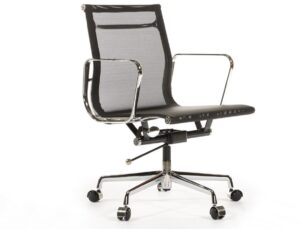
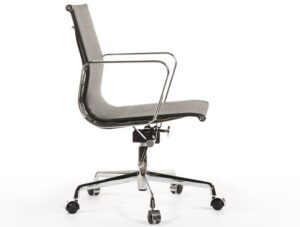
Managment: H 31-34" D 23" W 23" Seat H 17-20"
Arm H 26-29"


Side Chair: H 34" W 23" D 23" Seat H 18.5"


Lounge: H 37" D 32.5" W 26" Seat H 15"


Ottoman: H 20" D 22" W 21.75"


Available in Side | Management | Executive | Lounge models and was the precurser to the Soft Pad version shown below.


softpad_600x150.jpg


  image credit + license


Designed by Ray and Charles Eames in 1969


The chair evolved from the Eames aluminum group


With the addition of 2 inch-thick seat cushions, the soft pad chair retains the style of the earlier group, but makes gains in comfort.


Features adjustable tilt and height, soft, thick cushions, and a solid die-cast aluminum base, frame, and arms.


Management: H 34" D 17.5" W 23"
Seat Height 18.5-21" adjustable
Arm Height 26-29"


executive_chair_600x150.jpg


image credit + license 


26.5"w · 29.5"d · 35.5"h
seat height 18.5" (max)


Charles and Ray Eames designed Eames executive chairs in 1960 to grace the lobbies that they designed for the Time-Life Building in New York City. That's why some people call them Time-Life chairs.


Was originally referred to as the 3474 Tilt-Swivel chair.


Developed to meet the need for a comfortable chair that was smaller than the Eames lounge chair.

In 1972, chess grand master Bobby Fischer specifically requested the Eames executive chair while he competed in the World Chess Championship in Reykjavik, Iceland. He said he could concentrate well in the chair. When opponent Boris Spaasky saw it, he refused to play until he was given one as well.


By 1970, Herman Miller changed the designation of this chair. What was known here as the "3474" chair was given a new "name" in 1970 and thereafter: the "ES 104 adjustable tilt swivel chair."  You can see one of the original promotional brochures HERE .


| 963 Hits

| 201 Hits

| 225 Hits

| 69 Hits

| 67 Hits


eames_la_chaise_600.jpg


image credit + license  

Motivated by the urgent need for low-cost housing and furnishing designs in the immediate postwar period, MoMA sponsored the "1948 International Competition for Low-Cost Furniture Design." Charles made prototypes of "La Chaise" for this competition


the seat was inspired by Gaston Lachaise, the floating figure sculpture.


This model was reproduced around 1990 by Vitra.


Philippe Starck and Woo Bajolyodin are two of the fans of this model, which they proudly display in thier homes.


Dimensions:
H 34.25" D 35.5" W 53"
Seat Height 15.5"

Materials:
Chromed steel legs; fiberglass shell; solid oak base.


eames_chaise_600.jpg


Just 18 inches wide, this lightly scaled chaise fits in a study, an office - even a hallway. Its soft foam cushions rest atop a gently sloping frame and two loose cushions give added support under the neck, back or legs. Remarkably comfortable, the development of the chaise was inspired by Hollywood director Billy Wilder. In a conversation with friends Charles and Ray Eames, Wilder mentioned that he often took his afternoon nap on a foot-wide plank slung between two sawhorses in the Nova Scotia lighthouse where he was filming "The Spirit of St. Louis." Wilder's unique solution stayed with the Eameses, who introduced their beautifully sculpted chaise in 1968.


Dimensions:

H 29.5" D 76.5" W 18"


Materials:

Black leather upholstery; 2-inch-thick urethane foam cushions with polyester fiber batting; nylon supporting sling. Die-cast aluminum frame coated with eggplant-colored, electrostatically applied nylon; high-impact, black nylon glides.

| 658 Hits

The light-scaled Eames sofa compact gives all the comfort usually associated with long, low, heavy sofas. Two horizontal foam pads form the sofa's comfortably high back. A black enameled steel frame and chrome-plated tubular steel legs provide the foundation. It fits well where bulkier, traditional sofas don't and is perfectly scaled for tight spaces in executive suites, lounges and homes. The sofa has been in continuous production by Herman Miller since 1954.


The sofa compact's striking profile and crisp, light scale evolved from a built-in sofa that Charles and Ray Eames designed for the living room of their Pacific Palisades home. Knowing this makes the name "compact" seem less curious for a sofa that's over 6 feet long and provides such comfortable support from shoulders to knees. 


Designed in 1954, the Eames; Sofa Compact, another landmark of pared-down modernist design, is a luxuriously comfortable sofa that fits where most sofas won't. A mere 30" in depth, it occupies perhaps half the space of a traditional sofa. Its trim profile makes it ideal for reception areas, foyers, the executive office or any interior where space is tight and elegance is required.


Dimensions: 

H 35" D 30" L 72.5"
Materials:
Chromed steel frame; fabric reinforced rubber web suspension; stainless steel glides; 100% polyester crepe upholstery. 

eames_sofa_compact_600.jpg


 The Eames sofa is the last piece of furniture produced by the Eames Office, which completed the design after Charles Eames died in 1978. It went into production in 1984 and has been manufactured by Herman Miller ever since.


With its emphasis on beautiful materials and simplified forms, the Eames sofa exemplifies the best in modern furniture design. Its angled profile and clean planes showcase a harmonious combination of rich walnut or teak, soft leather, and polished aluminum. Equally fitting for the contemporary home or office, it's a luxurious place to settle back and relax. Available with two or three seats. 


Dimensions:

H 33" D 30" W 56"

Materials:

Leather upholstery; solid walnut frame and back; die-cast polished aluminum legs and arm supports 

eames_sofa_600.jpg


 Charles and Ray Eames originally designed their tandem sling seating for Chicago's O'Hare International Airport in 1962 to address the need for comfortable, attractive, and sturdy public seating. They based the design on the sling system developed for their aluminum group chairs.

To test the strength and durability of tandem sling seating, Herman Miller tested a prototype by dropping a 100-pound weight on a seat pad 15,000 times at a height of 5 inches. In real life, tandem sling seating has proven its durability under the most grueling conditions every day, around the clock.


A study in beautiful contrasts, this sofa has a clean, angled profile that showcases its fine materials - rich walnut, soft leather, polished aluminum. Back panels are fashioned from solid walnut, hand-finished with gunstock oil. Seat cushions rest on fabric-reinforced rubber webbing for resilient body support and comfort. The design was nearly complete when Charles Eames died in 1978; the Eames Office finished the design, and Herman Miller began manufacturing this last Eames piece in 1984. This original is an authentic,


Fits the Space
Configuration freedom. Up to 7 seats or tables attach in any order to the polished-aluminum support beam; seats can also be arranged back to back.

Light appearance. Complements a public space without overwhelming it.

Serves the Public
Comfort for travelers. Seats are wide and padded; open seat-to-back angle.

Room for baggage. The support-beam design leaves plenty of space under the seats.

Built for 24-7 Use
Joint-free. Continuous die-cast aluminum chair frames and support beams provide maximum strength.

Foam pads. Pressed and sealed between two layers of vinyl for a durable, wrinkle-free surface.

Easy Care
No stitch lines. Dust can't gather.

On-site maintenance. Seat and back pads are the same size and interchangeable; along with arm pads, they can be replaced on site. 


eames_tandem_600.jpg

| 591 Hits

eames_screen_300.jpg


                                                                   image credit: JoeBehrDenver


This flexible plywood screen consists of thinner plywood units. This product varies in height and in the number of plywood units used. At first, plywood screens were also created in red, black, and other colors. Screens could be made to order, and examples of these include a huge screen comprised of tens of panels. Its design shows the influence of Alvar Aalto, whom Charles respected.


n their early experiments in molded plywood, Charles and Ray Eames were intrigued to see if they could create structures stable enough to stand. This idea soon became reality in a portable, foldable way to divide space, known as the Molded Plywood Folding Screen (1946). Standing almost six feet tall, the screen is made up of six U-shaped panels that have natural face veneers and lightweight walnut inner plies. These panels were originally held together with canvas hinges and a synthetic adhesive developed during WWII. Today, the screen is made with a polypropylene mesh that's more flexible and longer lasting. Shift the footprint of the undulating panels to fit the space needed, and when not in use, fold the screen for compact storage. 


Charles and Ray Eames noted that U-shaped cross sections of plywood from their early molding experiments were stable enough to stand alone. To make their screen, they joined the sections with canvas hinges and a synthetic adhesive developed during World War II. Today, a polypropylene mesh held securely by a new process ensures a longer life without compromising the integrity of the 1946 design. You get a portable, foldable, enjoyable way to divide space and give privacy.
 

The molded plywood folding screen features six panels connected by woven polypropylene mesh. The hardwood inner ply is sandwiched by natural face veneers available in your choice of four finish options.


Dimensions:
H 68" W 60" D 2.25"
Materials:
Molded plywood sections; natural face veneer in ash, ebony, walnut or cherry; walnut inner plies; woven polypropylene mesh.

eames_splint.jpg


                                                                   image credit: kim+jeffrey


The Eames Molded Plywood Splint US Navy in 1943

The famous icon of American Modernism, design by Charles and Ray Eames for the U.S. Government to transport wounded soldiers off the field. The precursor to the early plywood furniture.
Produced for the United States Navy by the Evans Products Company, Molded Plywood Division for injured servicemen. These splints are truly beautiful and an important milestone on the Eames journey.

A little bit of history:

The last thing the landlord expected when he rented a modest Richard Neutra-designed apartment on Strathmore Avenue in the Los Angeles suburb of Westwood to a newly married couple in 1941 was for the spare bedroom to be turned into a workshop. No sooner had Charles and Ray Eames moved in than they kitted out that room with a home-made moulding machine into which they fed the woods and glues that Charles sneaked home from his day job as a set architect on MGM movies like Mrs Miniver.It was on this machine - dubbed the "Kazam!" after the saying "Ala Kazam!" because the plywood formed in the mould like magic - that the Eames produced for the Navy, their first mass-manufactured product, a plywood leg splint based that kept an injured leg stable during transport, on a plaster mould of Charles' own leg. The splint is beautiful, elegant, simple, and functional, and it solved a problem in a way that worked for everybody. One of the most important things about that object is that when you see it, you immediately know what it is. The design makes it instantly recognizable. Too often, we confuse design with marketability -- a product with a label that tries to tell us that the product is a "good" design.
A year later, the US Navy placed an order for 5,000 splints and the Eames moved their workshop out of their apartment into a rented studio on nearby Santa Monica Boulevard.

The Eames splint is recognizable by its simplicity -- a three-dimensional outline of a space created by a leg. It achieves its intent and its function with no extraneous moves; it's anti-rococo. But simplicity does not mean simplistic -- something that's simplistic is made without thought.


During World War II, the U.S. Navy called upon Charles and Ray Eames to create a lightweight, inexpensive leg splint. The resulting design is a highly sculptural yet functional device that could be mass-produced and, being modular, conveniently and inexpensively transported. Access to military technology and manufacturing facilities allowed the Eameses to perfect their technique for molding plywood, which they had been working on for several years. In its three-dimensional, biomorphic form, the leg splint suggests the Eames' subsequent, highly influential plywood furniture designs.


manufactured by Evans Products, Molded Plywood Division


The first product to reach the production line was a leg splint, somewhat unlikely for one of the twentieth century’s greatest product designers, but timely to say the least. In 1943 the US Navy placed an order for 5000 leg splints, enabling the Eames to move out of their apartment and into ritzier territory on Santa Monica Boulevard.


Dimensions:

H. 42 1/4 in. (107.3 cm), W. 7 7/8 in. (20 cm), D. 3 1/2 in. (8.9 cm)


eames_plywood_elephant.jpg


                                                                    image credit: brandon shigeta


 To celebrate the 100th birthday of Charles Eames, Vitra is introducing a limited anniversary edition of the Eames Plywood Elephant, a legendary furniture sculpture that was designed in 1945 but never produced for general distribution and sale. Of the two known prototypes, only one remains in the Eames Family Archives.

Charles and Ray Eames were fascinated by elephants. Many images of these gentle giants are found in Charles' photographic documentations of Indian culture and the circus world. The Plywood Elephant was designed as a toy for children, but also as a striking sculptural object that makes a statement in any environment with its vigorous curves and delightful character.


To commemorate Charles Eames' 100th birthday June 17th, Vitra is producing one of the animals, the elephant, in a limited series of 1,000,


During the early 1940s Charles and Ray Eames developed a successful technique for molding plywood into three-dimensional shapes, which led to the creation of a variety of furnishings and sculptures. The Plywood Elephant, in particular, has attained legendary status among collectors. Designed in 1945, this piece requires complex fabrication methods. Only two prototypes were produced, both of which were subsequently displayed in an exhibition at the New York Museum of Modern Art. Today only one known model remains in the possession of the Eames Family.

Charles and Ray Eames were fascinated by elephants. Many images of these gentle giants are found in Charles' photographic documentations of Indian culture and the circus world. The Plywood Elephant was designed as a toy for children, but also as a striking sculptural object that makes a statement in any environment with its vigorous curves and delightful character. There is a playful charm in the way that the Eames’ used juvenile motifs to create a vibrant, cheerful idiom that appeals to adults as well as children.When the Japanese design magazine Casa Brutus ran an all-Eames issue in 2001, it included a papercraft version of the Plywood Elephant that was so popular, they reprinted it. A couple of years later, an Eames-related mook came out with the papercraft elephant, too. [The mook is 1260 yen at Amazon JP; you can still get Casa Brutus for $20 from EamesGallery.com.]


Dimensions:

30" trunk to tail, 14" wide and 16 5/16" tall


eames_hang_it_all.jpg


                                                                     image credit: apartment therapy


In the mid-1940s, the Eameses began to design toys and furniture for children, including molded plywood animals, colorful building blocks and whimsical masks. This brightly colored hang-it-all holds jackets, caps, skates, backpacks and almost anything else. Includes hardware package with drywall anchors and screws. 


Beginning in the mid-1940s and continuing throughout their careers, Charles and Ray Eames designed a variety of whimsical toys and furniture pieces specifically for children, including this 1953 piece for Tigrett Enterprises Playhouse Division.

Why children's products? For purely personal reasons: Charles and Ray wanted to give them to their own grandchildren and to the children of friends.

The Hang-It-All--along with molded plywood animals, small-scale chairs and tables, elaborate cardboard-and-paper masks, and brightly colored building blocks--were all given the same careful design consideration as the couple's furniture designs.

To achieve the Hang-It-All's spidery base, the Eameses used the mass-production techniques for welding wires that they developed for their wire-base tables and wire chairs.


Dimensions:
H 14.625" W 19.75" D 6.5"
Materials:
Steel rod frame with white powder coat; painted solid maple balls in nine colors.

| 446 Hits


It was selected as "best design of the century" by Time magazine in 1999. 


The chair is in the permanent collection of New York's Museum of Modern Art.


In the early 1940s, when Charles Eames was working on MGM set designs, he would return to the small apartment where he and his wife, Ray, were experimenting with wood-molding techniques that would have profound effects on the design world.  Their discoveries led to a commission from the U.S. Navy in 1942 to develop plywood splints, stretchers, and glider shells molded under heat and pressure.

After World War II, they adapted this technology to create inexpensive, high-quality chairs that could be mass-produced. The process eliminated the extraneous wood needed to connect the seat with the back, which reduced the weight and visual profile of the chair.


Other designers like Swedish designer AlvarAalto, had employed bent and laminated plywood in their modern furniture designs earlier, it was the Eameses process that allowed for sculptural and organic compound curves in their plywood designs.


In 1941 the Museum of Modern Art held a competition organized by Eliot Noyes to discover imaginative designers for contemporary living. Prizes were awarded to Eames and Saarinen for these chairs and storage pieces, by a jury that included Edgar Kaufmann Jr., Alfred H. Barr of the Metropolitan Museum of Art, Eliot Noyes, Marcel Breuer, Frank Parrish, and architect Edward Durrell Stone.


The chairs were shown in 1946 in a Museum of Modern Art exhibition, New Furniture Designed by Charles Eames. At the time of the exhibit, the chairs had only three legs, and problems of stability discouraged mass production.


Designs with four wooden legs were first produced in 1946 by Evans Products Company (Eames' wartime employer) and distributed by the Herman Miller Furniture Company.


Later versions with metal legs were produced in 1951, including the LCM (Low Chair-Metal) and DCM (Dining Chair-Metal) models. Matching dining and coffee tables were also produced. The line was produced until 1957, then re-issued in 1994.


Earned the nickname "the potato chip chair" for it's organic looking plywood seat and back.


Sometimes referred to as the "most famous chair of the century,"


Materials:
Molded 5-ply seat and back; 8-ply legs and back brace; rubber shock mounts; self-leveling nylon glides.


Plywood Dining Chair,


DCW (wooden legs)

Dimensions:
H 28.75"  D 21.75 " W 19.5"  Seat H 18"


DCM (metal legs)

Dimensions:
H 29.5" D 20.5" W 20.5" Seat H 17.5"

 
Plywood Lounge Chair


LCW (wooden legs)

Dimensions:

H 26.5" D 24.5" W 22"


LCM (metal legs)

Dimensions:
H 26.5" W 22" D 24.5" Seat H 15.5"


plwood_chair_dcw_600.jpg


image credit :silverbelly

| 1289 Hits

General Info


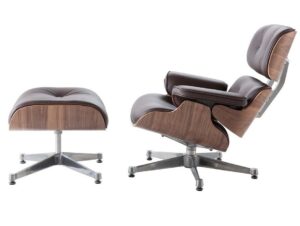
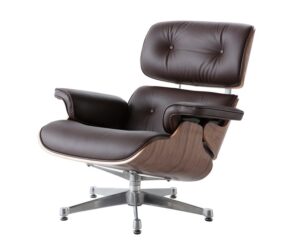
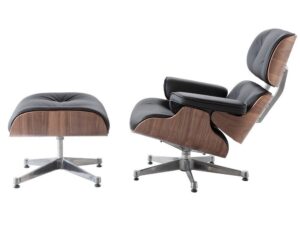
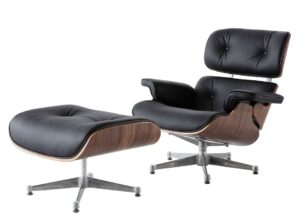
Is widely considered one of the most significant designs of the 20th century, it is featured in the permanent MOMA collection .


Correctly titled the 670 for the lounge, and 671 for the ottoman.


Designed using the molded plywood technology that the Eames pioneered in the 1940's.


In continuous production since its introduction in 1956, for Herman Miller, made its public debut on Arlene Francis' Home show, which later became the Today show.


Debut Film (Starts around 3:40) Part 1


In Charles Eames' words, the vision was for a chair with the "warm, receptive look of a well-used first baseman's mitt.".  It was the first chair the Eames designed for the higher end furniture market.


 Since its introduction, the chair has been in continuous production by Herman Miller. Vitra began producing the chair for the European market.


Dimensions:

Chair, H 33" D 33" W 33" Seat H 15"
Arm H 20.5" Ottoman, H 17.5" W 26" D 21.5"

dimensions.jpg


Materials:
7-ply cherry or walnut veneer frame; molded plywood frame; leather upholstery; urethane foam padding; die-cast aluminum braces and stainless steel glides.


Gallery


Shopping Guide


  Impex:  $518


  * Exclusively Home: $999


 Modern Reproductions: $1309 


  * Paradigm Gallery: $1595


 Modern Dose:  $1675


 2b Mod: $2200


___________________________________


 Modern Seed:  $3499


 * Home Office Solutions: $3599


 * Office Designs: $3599


 Hive Modern: $3599


 * All Modern: $3599


 Room & Board:  $3599


 * Sit 4 Less: $3599


 * Amazon: $3599 + Palisander $4499


 Eames Office: $3599


 Moma Store: $3995


| 2085 Hits

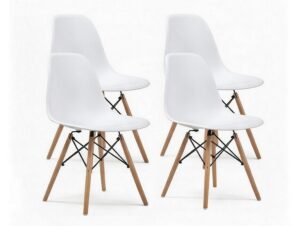
  The current models looks exactly the same as the originals. They remain unupholstered, in keeping with the Eameses requirement that materials be expressed honestly and unselfconsciously. In fact, these were the first one-piece plastic chairs to be left uncovered.

At the same time, the chairs are better than ever. For example, the shell is now manufactured using more environmentally friendly, high-impact plastic.


eames_plastic_sidechair_300.jpg


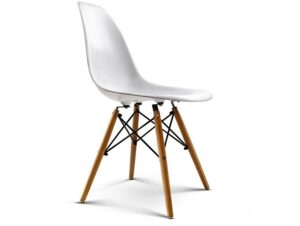
The first successfully mass-produced molded plastic chairs, these were molded in fiberglass reinforced polyester and designed by Charles Eames (1907-1978) in 1948.


They were introduced in 1951 by the Herman Miller Furniture Company and were produced in a variety of individual variations through 1995.


This DAR (dining and desk chair) model illustrated has a lightweight structural wire base, often called the "Eiffel Tower". The RAR version had birch wood rockers on the bottom. Other standard models (DAX, LAX and SAX) had more traditional bent metal legs, some with swivel seats.


This design was originated by Eames in a similar organically-shaped one-piece stamped metal bucket seat in his winning design in the Museum of Modern Art's international competition for Low Cost Furniture Design in 1948. The competition was in collaboration with furniture retailers like Herman Miller, who agreed to produce the winning designs commercially.


In 1946, Eames' original molded plywood chairs had been made by Evans Products Company and distributed by Herman Miller. In 1947 George Nelson (1908-1986) bought the tooling for Herman Miller, which then continued production until 1957. In 1994, they were re-introduced.


Plastic Armchair: DAW, PAW
(dining height armchair wood base)
(pivot armchair wood base)

PAW: This is also the plastic armchair manufactured by Zenith. The steel rods support the wood legs ("dowel legs") with a swivel. As this wonderful model illustrates, Charles was particularly skillful at combining different kinds of materials. Because the wood legs break easily, very few of these Plastic Armchairs remain in complete and good condition.


Plastic Armchair: DAR, LAX
(dining height armchair r-wire base)
(lounge height armchair x-base)

The chair bases were made of metal rods that were resistance-welded for stability. Like most of the Eames' furniture, the bases aquired funny descriptive names from consumers, names like cat's cradle, X-base, and the Eiffel Tower. The Eames' fiberglass chairs were eventually offered with over two-dozen different bases that rocked, swiveled, rolled, adjusted, or just "sat" there.


Plastic Armchair: LAR, RAR
(lounge height armchair r-wire base)
(rocking armchair r-wire base)

RAR: This plastic armchair on a rocker-base comprised of wood rockers and steel rod legs was manufactured by Zenith. This model is rare, for it was only produced during the first year of the Eames rocker-based chairs, and subsequent models had a slightly different rod configuration. The rocker version of the Plastic Armchair was produced for commercial sale until 1968. Until 1984, Herman Miller gave this chair as a gift to everyone of his employees who became a parent.


The Eames Molded Plastic Rocker (1948), often known as the RAR (rocking armchair rod), was out of production for 30 years before being brought back with the blessings of the Eames Office. Originally manufactured in fiberglass-reinforced plastic, this classic rocker was updated in durable and environmentally friendly molded polypropylene. This molded shell has a deep seat pocket, integrated armrests and a high backrest. The waterfall seat edge promotes comfortable seating for extended periods of time by reducing pressure on the backs of thighs. The iconic Eames wire base is set atop two maple runners for a smooth rocking motion that brings enjoyment to contract and residential settings. This original is an authentic, fully licensed product of Herman Miller, Inc. Eames is a licensed trademark of Herman Miller, Inc.

Dimensions:

H 26.5" W 24.5" D 27" Seat H 16" Arm H 23.5"
Materials:
Batch-dyed polypropylene shell; chromed steel base; hard maple runners with clear laquer finish.


Plastic Armchair: PAC, DAT
(pivot armchair on cast base)
(dining height armchair tilt swivel base)

DAT: Manufactured by Herman Miller, the height of this armchair can be adjusted by a tilting unit located under the shell. The base with full swiveling casters is common to all Eames chairs designed for office use. The die-cast aluminum foot pieces are characteristic of the works after the Aluminum Group (1958). The rather Spartan design of this base has a very different charm from the earlier chairs.


Commonly referred to as Eiffel chairs, the Eames Molded Plastic Armchair and Side Chair (1948) were the first industrially manufactured plastic chairs. In creating these classic pieces, the Eameses honed two techniques with which they had been grappling for years: the use of a bent and welded wire base and a sculpted plastic shell seat. The results are supremely comfortable and timeless. Originally made with fiberglass-reinforced plastic, these chairs now take advantage of the benefits of more eco-friendly polypropylene. The molded shell seat has a high, flexible back and a deep seat pocket. The waterfall seat edge promotes comfortable seating for extended periods of time by reducing pressure on the backs of thighs. For residential and commercial use.

Dimensions:

H 32" W 24.5" D 23.5" Seat H 16.5" Arm H 26"
Materials:
Polypropylene; chrome-plated steel base; plastic glides.


Plastic Side Chair: DSR, DSG, LSR, DSS-TA
(dining height side chair r-wire base)
(dining height side chair wall guard base)
(lounge height side chair r-wire base)
(dining height side chair stacking table base)

n 1950, the Eameses developed the first model of the "armless" side shell chair manufactured by Zenith Plastics, makers of the earlier bucket shell chair.

Bases available for this side chair were rod-legged, cast aluminum pedestal, swivel, wire strut which is known as the "Eiffel-tower" base, wood-legged, or wood rockers on wire struts. The later production model of this chair had a lighter seat and new H-base leg configuration. It also used the sturdy first generation self-leveling glides for the new, hollow leg configuration. The shells themselves have not changed their sculptural shape in over 50 years of production, having maintained their visual appeal as originally designed.


Commonly referred to as Eiffel chairs, the Eames Molded Plastic Armchair and Side Chair (1948) were the first industrially manufactured plastic chairs. In creating these classic pieces, the Eameses honed two techniques with which they had been grappling for years: the use of a bent and welded wire base and a sculpted plastic shell seat. The results are supremely comfortable and timeless. Originally made with fiberglass-reinforced plastic, these chairs now take advantage of the benefits of more eco-friendly polypropylene. The molded shell seat has a high, flexible back and a deep seat pocket. The waterfall seat edge promotes comfortable seating for extended periods of time by reducing pressure on the backs of thighs. For residential and commercial use.

Dimensions:

H 31.5" W 18.5" D 22" Seat H 17.5"
Materials:
Polypropylene; chrome-plated steel base; plastic glides.


Stacking Chair: DSS
(dining height side chair stacking base)


Wire or four-legged base


18.5" w | 22" d | 29.87" h
Stacks up to 14 chairs high.


.


                                                                    image credit: tiloe

eames_sidechair_600.jpg


 image credit: ekai


eames_plastic_armchair_600.jpg


image credit: bjosefowicz


eames_plastic_rocker_600.jpg


image credit:  mdumlao98
 

| 2066 Hits

  Design Charles & Ray Eames, 1960.
Solid walnut. Made by Herman Miller®.


Perfectly self-contained objects of beauty, these solid walnut stools can act as a low table or a simple seat; hold a stack of books or coffee cups; live in modern or traditional surroundings. Charles and Ray Eames first designed the stools in 1960 for the lobby of the Time Life Building in New York City, but they soon became popular products and with time, one of the more charming classics of modern design. Today, these finely crafted lathe-turned pieces bring an animated personality to the office, home or commercial space.


center section of the stool comes in three distinctively sculpted profiles. The top surface and the smaller bottom surface are both concave.


Ray Eames drew on her training as a sculptor to design a new kind of occasional piece for the lobby of the Time-Life Building in New York City. Eames walnut stools became her favorite seats and were liberally scattered about the Charles and Ray Eames home in Pacific Palisades. Made of solid walnut, these stools can be used anywhere and are beautifully versatile. Besides being places to sit, they also serve as low tables, display surfaces, or simply objects of art to be admired.

A museum curator once ordered two of these stools for his son and daughter. "Graduation gifts?" he was asked. "No," he said, "the kids are only five and three. But I want them to have the experience of growing up with something truly good that they can keep all their lives."


Dimensions:

H 15" W 13.25" Seat Height 15"
Materials:
Solid walnut.


eames_walnut_stools_600.jpg


 image credit:黃毛


| 497 Hits

<< Start < Prev 1 2 Next > End >>
  

Powered by AlphaContent 3.0.3 © 2005-2008 - All rights reserved