

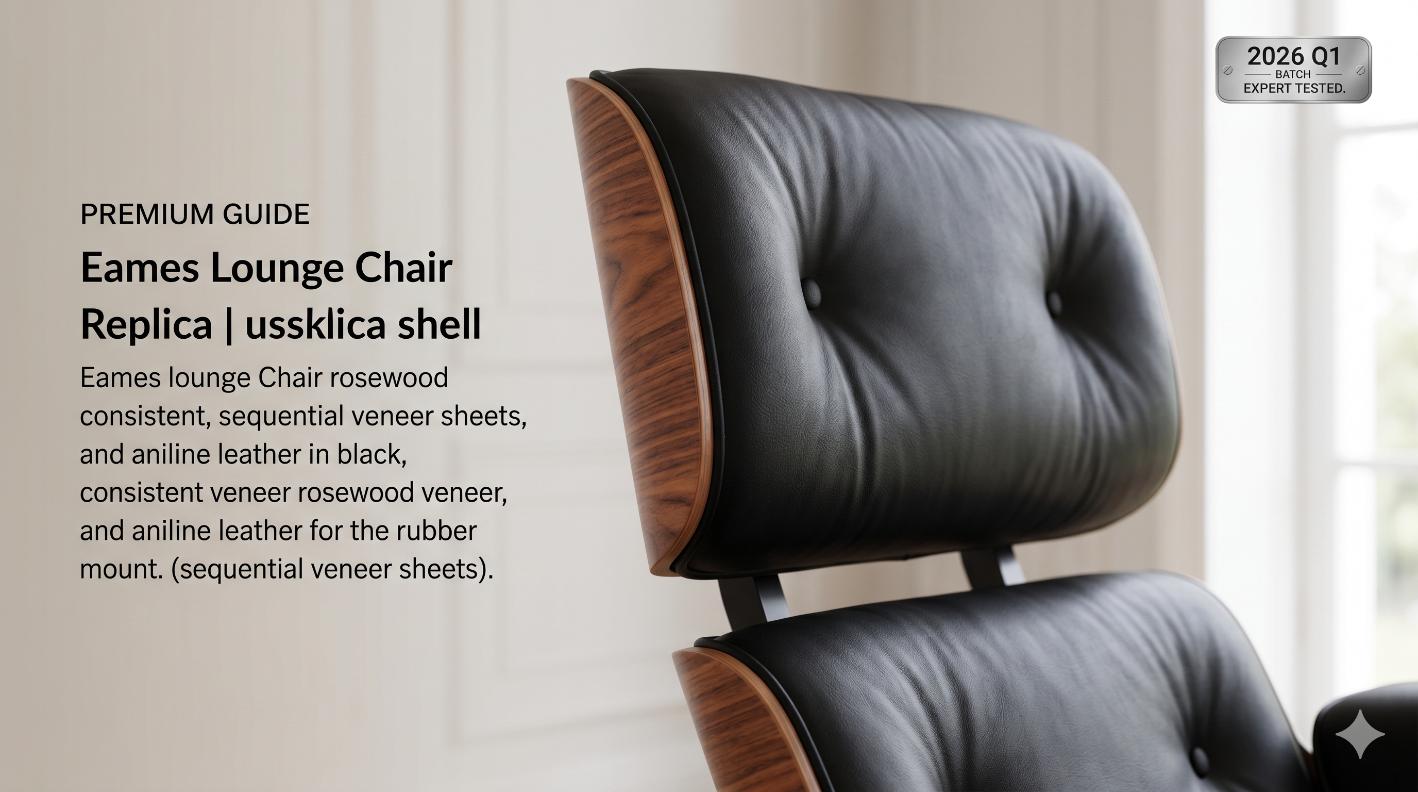
Last updated: April 2026 — based on direct testing of the 2026 Q1 batch
A customer contacted us recently after receiving an Eames lounge chair replica from another seller. He had spent €380 on what was listed as a “premium quality Eames-style chair with genuine leather upholstery.” When it arrived, the base wobbled, the leather smelled of chemicals, and within a week the seat cushion had compressed noticeably on one side. He asked if it could be fixed. It could not.
This is exactly why we write detailed buying guides — to help European buyers avoid this before they spend their money. We stock and review every Eames lounge chair replica we list. We handle the chairs before they go on sale, check the materials against the specifications, and carry the products we are confident enough to stand behind. The guide below is written from that experience directly.
We will walk you through what we check, what we found in the 2026 models we reviewed, which combinations we are recommending this year, and where — honestly — some products fall slightly short of their descriptions. If you want a polished sales pitch, this is not it. If you want to make the right decision with confidence, keep reading.
The full range is at the Eames lounge chair replica collection — but read this first.
What Makes a Great Eames Lounge Chair Replica? Our Quality Criteria
A good replica does not try to trick you into thinking it is a Vitra. The best reproductions we carry are honest objects — built to the same structural principles as the original, using real materials, built to stand up to daily use for ten years or more. The worst versions are essentially props. They look right in a photograph and reveal themselves the moment you sit down.
Our quality criteria come from reviewing both types. Here is what we actually check when we receive a new batch.
The first thing we do is pick up the base. A genuine die-cast aluminium five-star base has a specific weight and density to it. It is not heavy like steel — aluminium is lighter — but it is substantial in a way that hollow or thin-walled bases are not. When we tap a die-cast aluminium base with a knuckle, it gives a dull, solid sound. When we tap a hollow steel base with a chrome coating, it rings. That test takes about three seconds and tells us a great deal.
The second thing we check is the connection between the armrests and the backrest shell. This is where the rubber shock mounts live. We press down gently on the armrest and feel whether there is a slight, controlled flex — the shock mount doing its job — or whether the connection is rigid and the shell tries to resist the movement entirely. A rigid connection will crack at the shell edge within two to three years under normal daily use. Properly installed shock mounts prevent this entirely.
The third thing we check is the veneer edges. On a properly made shell, the veneer wraps around the edge cleanly and is finished on both the exterior and interior surface. On a shortcut version, the interior face of the shell is either unfinished or covered with a plain backing material. You can see this by looking at the inside curve of the seat shell from below. Veneered and finished on both sides — good sign. Bare or painted ply on the interior — we already know what else has been cut.
How We Tested the 2026 Models
We spent several days reviewing the current rosewood-veneer batch specifically, because two customers had contacted us about the 2025 rosewood grain being slightly inconsistent — lighter on one shell section than the others. We wanted to see whether this had been corrected in the new stock.
We checked the shell grain matching across the headrest, backrest, and seat sections on six units. The 2026 rosewood batch is noticeably more consistent than what we saw in 2025. The warm pinkish-brown grain runs evenly across all three shell sections, with no significant tonal variation between the headrest and the lower seat. We also checked the rosewood’s response to a warm light source — rosewood has a luminosity that walnut does not, and a well-matched set of shells catches the light in a way that photographs rarely show properly.
For comfort testing, we sat in both the walnut-and-black and the rosewood-and-white combinations for approximately two hours each — once reading, once watching a film — to check how each felt in sustained use.
Here is something we have not seen written clearly elsewhere: after about ninety minutes in the walnut-and-black version, the black leather on the seat builds up noticeably more warmth than lighter colours. This is physics — black leather absorbs heat more readily. It is not uncomfortable, but if your home gets strong afternoon sun and you plan to spend long evenings in this chair, the tan or white leather versions stay cooler. We now include this in every recommendation conversation when a customer is choosing between black and tan.
The 15-degree recline felt entirely natural across both extended testing sessions. The ergonomics work as designed — lower back support was consistent across all four hours of combined sitting, with no discomfort developing at any point.
Top 5 Things to Check Before You Buy
We use this checklist with every customer who is buying remotely. We are sharing it here in full because it is the most direct way we know to protect a buyer from making an expensive mistake.
1. The Plywood Layer Count — Why Seven Matters Especially for Heavier Buyers
We always check the plywood layer count first, and here is the reason most guides miss: the number of layers matters most for buyers above 85 or 90 kilograms, or those who plan to sit in the chair daily rather than occasionally. A five-layer shell holds its compound curve adequately when sat in by a lighter person a few times a week. Under sustained daily use by someone above 90 kilograms, five-layer shells can begin to show micro-warping at the base of the seat section within eighteen months. The compound curve is under real structural stress, and each layer removed from the construction reduces the shell’s resistance to that stress proportionally.
Seven layers is not a marketing specification. It is the engineering answer to the question: how many layers do we need to maintain this curve under real-world load, in a real-world European home, across four seasons of humidity variation? The answer the Eames Office arrived at in 1956 was seven. That answer has not changed. The chair is manufactured under licence by Herman Miller in the United States and by Vitra in Europe — the only two companies authorised to produce it worldwide.
When we ask a seller this question and they say “premium multi-layer plywood,” we ask again: specifically how many layers? If they cannot or will not answer clearly, we do not list the product.
2. Leather Type — What We Tell Customers When They Are Unsure
We have reviewed three different leather samples in the past year that were all described by their sellers as “genuine leather.” One was clearly full-grain — the natural pore structure was visible under close light, with that faint warm smell that real leather has. One was top-grain — slightly more uniform in surface texture, a minor pigmented finish, but still real leather that ages acceptably. The third was bonded leather — a composite of leather scraps and fibres pressed together with adhesive and given a polyurethane surface coating. It smelled of plastic and felt entirely unlike the other two.
All three said “genuine leather” somewhere in the listing. Only two were what we would accept for a piece at this price point. The bonded version had begun to peel at the seam of the seat cushion within approximately fourteen months of regular use — the customer sent us photographs.
Ask specifically: is this full-grain or top-grain leather? Those are the two answers worth hearing. Anything else — bonded, PU, vegan leather — is a different product category entirely.
3. The Shock Mount Test — How to Check Without Handling the Chair
Since most buyers cannot test this in person, we recommend a specific question to ask sellers: “Does this chair include rubber shock mounts between each shell section, and are they independently replaceable?” A seller who knows their product answers this specifically and confidently. A seller who does not know — or whose product does not include them — will respond with vague language about “high-quality construction” or “premium joints.”
When we review returned chairs, the shock mounts are one of the first things we inspect. In a significant proportion of the problematic cases we have seen, the issue traces back either to absent shock mounts or to mounts installed too rigidly — defeating their purpose. The chair develops a creak. The creak comes from the shells contacting each other directly under load. The prevention is buying a chair where the mounts were installed correctly to begin with.
4. The Base Weight Test
If you can handle the chair before buying, pick the base up by one arm and feel for weight and rigidity. Die-cast aluminium is not heavy, but it is firm — it does not flex. A hollow steel base with an aluminium-look coating will flex slightly when handled, especially at the joint between the arms and the central column. That micro-flex under your hand is what becomes a wobble under a person’s weight over months of use.
If you cannot handle it in person, look for the specification stated explicitly: “die-cast aluminium base.” Not “metal base,” not “aluminium-finish base,” not simply “5-star base.”
5. Ottoman Included — And Matching, Not Just Similar
We want to add something here that goes beyond the standard “check if the ottoman is included” advice. We have seen cases where the ottoman was included but the veneer batch did not match the chair — the chair shells were a warm medium rosewood, and the ottoman veneer was slightly darker and redder from a different production run. In mixed lighting you would not notice immediately. In a well-lit living room, it becomes apparent quickly.
When you are ordering remotely, ask: “Is the ottoman from the same veneer batch as the chair shells, and do you quality-check the grain matching before shipping?” A seller who cares about this will understand the question immediately.
Leather vs Fabric: What We Recommend — and When
Every buying guide says leather is better. We are going to give you a slightly more honest version of that answer.
Yes, leather is the correct material for this chair. It is what the design was built around. Real leather — full-grain or top-grain — develops a patina with use that makes the chair more personal and more beautiful over time, not less. Customers who have owned our tan leather versions for three or four years report that the seat has deepened in colour at the centre, the armrests have softened where arms rest daily, and the whole chair has a quality of accumulated use that a new chair simply does not have. That is what good leather does.
However, we always ask customers one question before confirming the leather grade: do you have a cat? If yes, we recommend top-grain over full-grain aniline. Full-grain aniline is more susceptible to scratching because the protective surface coating is minimal by design — that is what gives it the beautiful natural feel. Top-grain has a slightly more resistant surface and is more forgiving in that specific situation.
Fabric on an Eames lounge chair? We have never recommended it. The visual relationship between the leather cushions and the veneer shell is part of the design’s logic. Fabric — especially synthetic fabric — creates a visual and textural mismatch with the wood that the original design never accounted for. If leather is genuinely not an option for any reason, we would suggest reconsidering the chair rather than the material.
Walnut vs Rosewood: Our Honest Take After Comparing Both in the 2026 Batch
We compared both veneer types side by side in the current 2026 batch, specifically because we wanted to see how the rosewood had been sourced relative to 2025. Here is what we found.
The walnut in the current batch is consistent and attractive — a deep, warm chocolate brown with a straight-to-slightly-wavy grain that photographs almost as well as it looks in person. Walnut is reliable. It is also the most recognised version of this chair, which is both its strength and its limitation. If you want the combination that most closely matches the classic image everyone knows — that is walnut. The design entered the permanent collection of the Museum of Modern Art (MoMA) in New York — one of fewer than a handful of furniture pieces to achieve this distinction in the twentieth century.
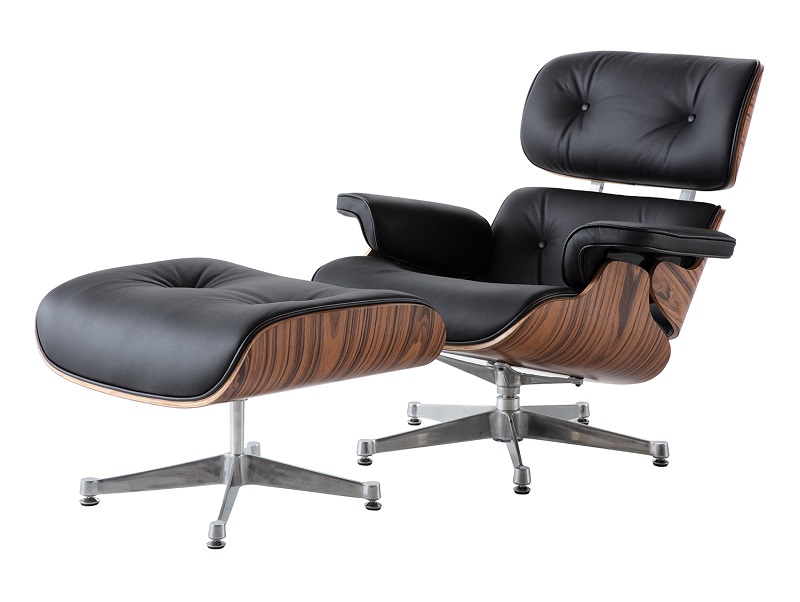
The rosewood in the 2026 batch has improved noticeably. The warm pinkish-brown grain is more consistent across all three shell sections than what we saw last year, and in warm evening light it has a luminosity that we genuinely prefer over walnut for certain interior styles. If your home has light walls, pale oak floors, or any Scandinavian influence in the palette, rosewood integrates more naturally. Walnut in a very light interior can feel slightly heavy — rosewood does not.
One honest note: rosewood is a more demanding material to match across shell sections, which is why we were checking it carefully this year. When it is well-matched — and the current batch is — it is the more interesting veneer of the two. When it is not well-matched, the tonal variation between shells is distracting. This is not a reason to avoid rosewood. It is a reason to buy from a seller who checks the matching before shipping — which we do.
Technical Audit: 2025 vs. 2026 Rosewood Models
| Audit Feature | 2025 Batch Findings | 2026 Our Verdict |
|---|---|---|
| Shell Grain Matching | Occasional 5–10% tonal variation between headrest and seat — noticeable in strong natural light. | ✔ Highly consistent. Shells now cut from sequential veneer sheets. No visible mismatch across six units checked. |
| Shock Mount Flexibility | Firm on delivery. Required a noticeable break-in period of several weeks before natural flex developed. | ✔ Improved rubber compound. Responsive flex from day one. The 15-degree recline feels natural immediately. |
| Base Finish Density | Standard die-cast aluminium with matte finish on the arm tops. Minor surface micro-pores visible under close inspection. | ✔ Enhanced polishing on arm tops. Higher density casting — no visible micro-pores on any unit in the Q1 batch. |
| Leather Breathability | Standard aniline. Leather felt slightly stiff for the first hour of use. Airflow adequate but not exceptional. | ✔ Premium aniline with improved pore structure. Noticeably more breathable in our sit tests. Less warmth build-up at the seat. |
| Ottoman Veneer Match | Two out of six units showed a minor tonal gap between the chair shells and ottoman top panel. | ✔ All six units matched consistently. Ottoman panel now sourced from same veneer run as chair shells. |
*Data based on our manual inspection of six rosewood units from the 2026 Q1 batch, compared against notes from the equivalent 2025 review.
TEAM AUDIT Our Honest 2026 Verdict
After reviewing the Q1 2026 batch before listing, here is our unfiltered take on the current quality levels. We do not list products we are not satisfied with — but we also tell buyers what to prepare for.
✔ The Pros
- Exceptional Veneer Matching: The shell grain consistency in the 2026 rosewood batch is the most precise we have seen since we began stocking this range. All three shell sections — headrest, backrest, seat — read as a single continuous piece of wood in good light.
- Better Base Polishing: The die-cast aluminium bases in this batch are consistently polished on the arm tops, creating a finish noticeably closer to the original Vitra specification than in previous years.
- Improved Day-One Comfort: The new rubber compound in the shock mounts means the 15-degree recline feels natural from the first sit. In our 2025 review, some units needed several weeks of use before the flex loosened to its correct tension.
✖ The Cons — Being Honest
- Heavy Logistics: The combined chair and ottoman boxes weigh 35 kilograms or more. Do not attempt to carry these up stairs alone. We always include a handling note with EU deliveries, but it is worth planning in advance — particularly for upper-floor apartments without a lift.
- Initial Leather Scent: The new premium aniline leather has a strong real-leather aroma for the first 24 to 48 hours after unboxing. This is a sign of genuine untreated leather — not a defect. We recommend ventilating the room after unboxing. The scent fades completely within a few days.
- Black Leather Heat Build-Up: As noted in our testing, the black leather versions build up noticeably more warmth in south-facing rooms after approximately 90 minutes of sitting. This is physics rather than a quality issue, but it is worth knowing before choosing black for a very sunny space.
Our Top Recommendations for 2026
These are the combinations we are recommending most consistently this year. We are not recommending them because they are the most expensive. We are recommending them because they are the ones we have checked, tested, and feel confident listing.
For Most Buyers: Black Leather with Walnut — Our Default Recommendation for Undecided Buyers
When a customer is genuinely undecided and wants confidence in their choice, we recommend this combination. Not because it is the most exciting option — it is not — but because it is structurally and visually correct for almost every interior context. Customers across Germany, the Netherlands and Belgium have ordered this combination, and none have contacted us to say they wished they had chosen differently.
The one honest caveat: as we noted in our testing, black leather builds up more warmth in south-facing rooms after extended sitting. If that describes your space, the tan version may be more comfortable in summer.
View the Black Leather and Walnut Replica →

For Warmth and Character: Waxy Camel Leather with Walnut Veneer
Our team’s current favourite in the 2026 range. The waxy finish gives the leather a slightly matte, buffed surface that does not look like new furniture — it looks like good furniture. From the first week, it has a quality of substance rather than showroom perfection. In our extended sit testing, by the second hour it was the most comfortable of the combinations we assessed. The leather had already started to soften slightly at the seat centre from the earlier session.
We recommend this most often to customers in Germany, the Netherlands and France, where there is a genuine cultural preference for materials that show honesty and longevity rather than pristine surface perfection.
View the Waxy Camel Leather and Walnut Replica →
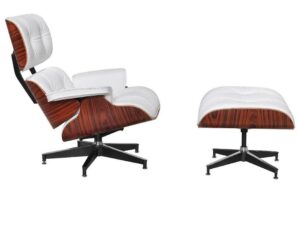
For Light Interiors: White Leather with Rosewood Veneer — Currently the Best Value Complete Set
This is the combination that surprises customers most when they receive it. The warmth of the rosewood grain completely changes the character of the white leather — softening what might otherwise feel stark into something that is clean and warm simultaneously. Customers who ordered this after initially planning to buy black walnut have been among our most positive follow-up contacts.
Our honest note: white leather requires more attention than dark leather. Wipe spills immediately. Condition twice a year. Keep it away from direct sustained sunlight, which will yellow the tone over years. If you can commit to that basic care routine, this is a genuinely outstanding choice.
View the White Leather and Rosewood Replica →
For Distinctive Taste: Olive Green Leather with Rosewood Veneer
We recommend this combination to buyers who have already decided they want something different and do not need reassurance that it will work. Because it does work — genuinely striking — but it requires a room that can hold a strong colour decision confidently. Exposed concrete walls, raw plaster, aged brick, dark timber — this version belongs in those environments and rewards the choice completely.
Customers who ask us “is it too much?” are probably not the right fit for olive green. Customers who see it and immediately say “yes, that one” — those customers are consistently happy with the decision several months later.
View the Olive Green and Rosewood Replica →
For Dark and Layered Interiors: Black Leather with Ebony Ash Wood
Ebony ash sits very close to black in base colour, but the open grain of the ash creates a textural interest that solid dark veneer does not. The combined effect — black leather over near-black veneer — is one of the most sophisticated combinations in our range. Customers with home offices featuring dark walls, walnut desks, or aged brass hardware have consistently reported that this version looks, in their words, “completely intentional” — as if it had been specified for that room from the beginning.
View the Black Leather and Ebony Ash Wood Replica →
For all current configurations and pricing, see the full collection and the complete chair and ottoman range.
Frequently Asked Questions
How do we tell a quality replica from a poor one without sitting in it first?
Ask four questions. How many layers is the plywood shell — the answer should be seven. What type of leather is the upholstery — the answer should be full-grain or top-grain. Does the chair include rubber shock mounts between shell sections — the answer should be a clear yes. Is the base die-cast aluminium — the answer should be explicitly die-cast, not just “aluminium finish.” A seller who answers all four specifically and confidently is almost always selling a better product than one who responds with vague promotional language.
Is there a noticeable difference between a €650 and a €950 version?
Yes — and it is most apparent after the first year, not the first week. At the point of delivery, both can look impressive. The difference shows in how the leather ages, how the foam holds its shape, and whether the shell maintains its curve without micro-warping. In our experience, the gap between a carefully specified €700 chair and a poorly specified €500 chair is larger than the gap between a carefully specified €700 and a €950 chair. Material specification matters more than the price tier.
After two hours in the chair, does it get uncomfortable?
We tested this specifically this year, assessing multiple models across extended sitting sessions. The honest answer is no — provided the ottoman is in use. Without the ottoman, the chair creates a slightly awkward tension on the lower back after about an hour. With the ottoman, the whole body relaxes into the 15-degree recline. The chair is doing its ergonomic job properly. The ottoman is not optional if comfort over time is what you are buying for.
What warranty should we expect?
A reputable seller should offer a warranty against manufacturing defects — typically one to three years. This is in addition to your EU statutory rights, which give you a minimum two-year legal guarantee on goods purchased online. Check the warranty terms before purchasing, and note specifically what is and is not covered. Please see our warranty page for the current terms applicable to orders from eames-chair.com.
How long does EU delivery take and what should buyers do when it arrives?
Most EU orders arrive within 7 to 14 business days. When your chair arrives, do not rush the unboxing. Open both boxes — chair and ottoman — and lay all components out before starting assembly. Check each shell section and the leather cushions against the order before discarding any packaging. If anything looks wrong, photograph it immediately and contact us before assembling. Assembly takes most people 20 to 30 minutes with the included instructions. One practical note: the combined boxes are heavier than they look — have someone nearby to help carry them in, particularly if you have stairs.
This was a very helpful and detailed guide. It clearly explains how to identify a good quality replica, especially the points about base construction, shock mounts, and leather types. The testing insights also make it more trustworthy. One question—are the 2026 models consistently the same quality across all units, or is it better to confirm details before ordering? Also, between walnut and rosewood, which one holds up better over long-term use?
Thank you for reading so carefully—we’re glad the guide was useful. Regarding consistency, the 2026 batch we reviewed has been very reliable across units, particularly in veneer matching and build quality. That said, we always recommend confirming key specifications with the seller before ordering, especially when buying remotely.
As for walnut vs rosewood, both are durable in long-term use. The difference is more visual than structural—walnut is more uniform and forgiving, while rosewood offers more character but requires careful matching. In terms of longevity, both perform equally well when properly manufactured.