
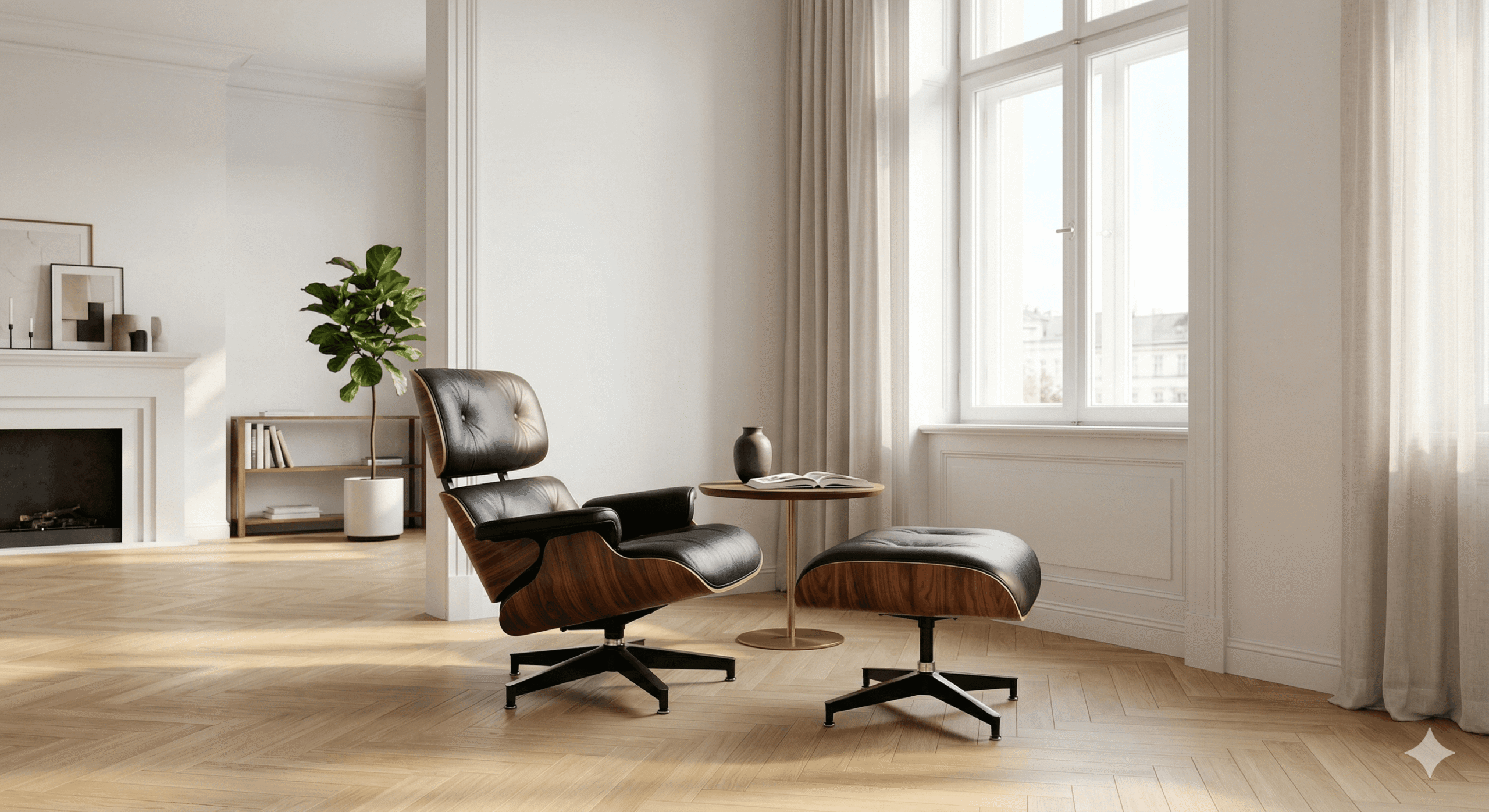
Some chairs are just chairs. The Eames lounge chair is not one of them. It sits in the permanent collection of the Museum of Modern Art in New York. It has appeared in James Bond films, in Frasier, in Iron Man, and in the homes of Steve Jobs, Billy Wilder, and countless architects, designers, and people who simply love beautiful things. It has been in continuous production since 1956 — nearly seventy years — without a single significant redesign.So what is so special about the Eames chair? That is the question this guide answers — properly, completely, and in plain language. Whether you are a design enthusiast wanting the full story, or someone who has just started researching before a purchase, everything you need to know is here.
Who Were Charles and Ray Eames?
Understanding what is so special about the Eames chair starts with understanding the people who made it — because the Eames lounge chair is a direct expression of how Charles and Ray Eames thought about design, materials, and human beings.
Charles Eames was born in St. Louis in 1907. He studied architecture, dropped out, and eventually ended up at the Cranbrook Academy of Art in Michigan — one of the most influential design schools in American history. It was there that he met Bernice Alexandra Kaiser, who went by Ray. Ray was a painter and textile artist with a background in abstract art. They married in 1941 and began one of the most extraordinary creative partnerships in the history of design.
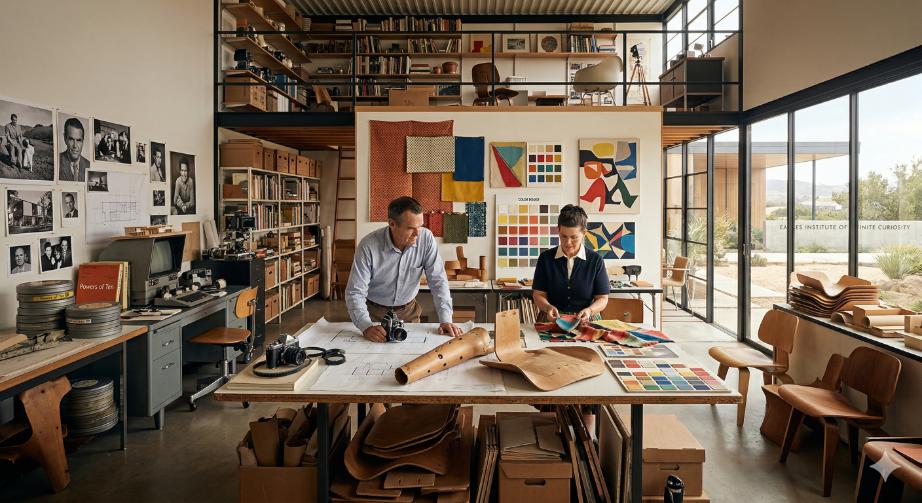
Charles and Ray were not specialists in the conventional sense. They moved between furniture, film, photography, architecture, and exhibition design with a restless, cross-disciplinary intelligence. Charles described their design philosophy simply: they wanted to get “the best to the most for the least.” Good design, honestly made, accessible to as many people as possible. That was the goal — every time, with every project.
Their early work with Herman Miller in the 1940s produced revolutionary experiments in moulded plywood — technology they had actually developed while making leg splints for injured American soldiers during the Second World War. That experience of bending and bonding plywood into complex curves under heat and pressure formed the technical foundation for everything that followed, including the lounge chair.
Charles Eames died in 1978. Ray died exactly ten years later, on the same date. Their archive, their studio, and their legacy are maintained by the Eames Institute of Infinite Curiosity in California. At eames-chair.com, we share their passion for bringing thoughtful design into everyday life.
What Is the Eames Lounge Chair?
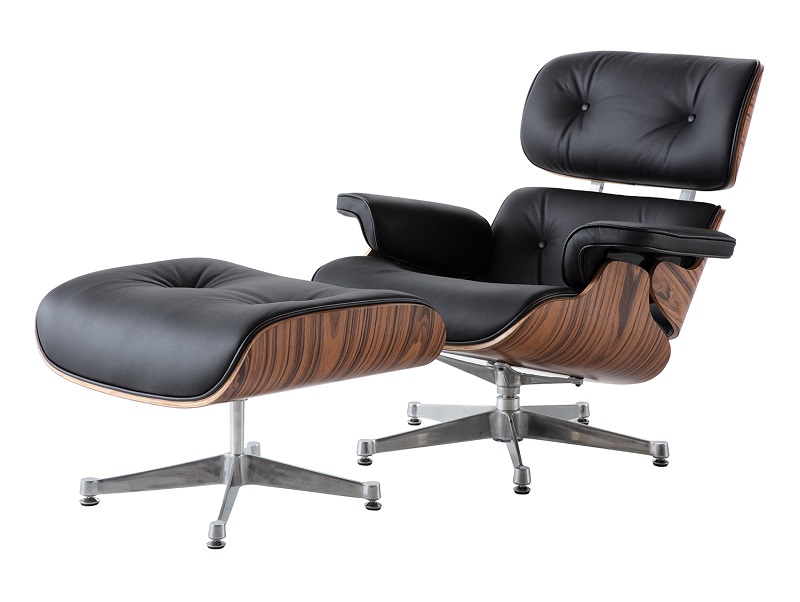
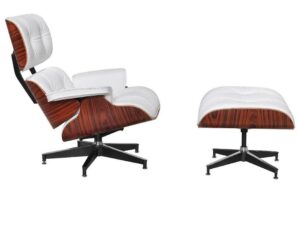
The Eames lounge chair — officially known as the Eames Lounge (670) and Ottoman (671) — was designed by Charles and Ray Eames and first produced by Herman Miller in 1956. It was their first and only design specifically created for the luxury market. Everything before it had been aimed at mass production and affordability. The lounge chair was something different.
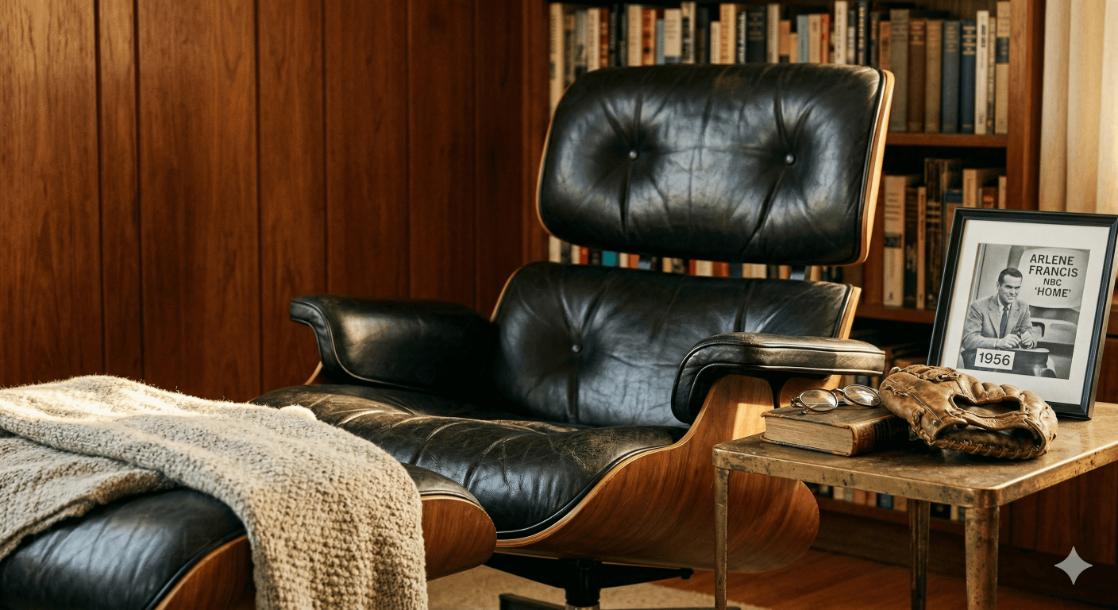
Charles described the inspiration behind it in two sentences that have become famous in Eames lounge chair history. He wanted the chair to have “the warm, receptive look of a well-used first baseman’s mitt.” Think about that image. A baseball glove that has been worn for years — softened, shaped, broken in, entirely personal. That is the feeling the Eames lounge chair was designed to evoke. Not newness. Not showroom perfection. Something that feels immediately yours.
Ray reportedly described the finished chair as “comfortable and un-designy” — meaning it did not look like it was trying to be a design object. It looked like something you actually wanted to sit in. That quality — the sense that the design has dissolved into pure comfort — is part of what makes the chair so enduringly special.
The chair debuted on national television in the United States on 1st January 1956, on NBC’s Home show hosted by Arlene Francis. Charles Eames appeared alongside his creation to introduce it. Within months, the chair was in production. It has never stopped.
Key Features of an Eames Lounge Chair
The Eames chair design looks deceptively simple. Three curved sections of plywood. Some leather cushions. A metal base. But every element has been engineered with precision — and that precision is exactly why the chair works as well as it does.
Three Separate Plywood Shells
The body of the chair is divided into three distinct sections — the headrest, the backrest, and the seat — each formed from seven layers of moulded plywood. Seven layers. Not five, not eight. Seven layers are what give each shell the correct combination of rigidity and flex. The shells bend slightly under body weight, absorbing movement naturally. Too few layers and the shell warps. Too many and it becomes stiff, losing the subtle responsiveness that makes the chair feel alive rather than inert.
The veneer — rosewood, walnut, or palisander depending on the configuration — is applied to both sides of each shell, not just the visible exterior. This is a structural and aesthetic decision. Both-sided veneer means the shell ages consistently and looks finished from every angle.
Rubber Shock Mounts — The Hidden Detail That Changes Everything
Between the armrests and the backrest shell, and between the headrest and backrest, sit small rubber components called shock mounts. They are invisible in normal use — hidden inside the connections between shells — but they are essential to how the chair feels.
The shock mounts allow each shell to flex independently. When you sit down, shift weight, or lean slightly, the chair moves with you rather than against you. This prevents the shells from cracking at the connection points under sustained load, and it gives the chair its characteristic quality of feeling slightly alive — responsive in a way that a rigid structure never can be. Most budget replicas omit these entirely. Their absence is felt immediately.
The 15-Degree Fixed Recline and Ergonomic Geometry
The seat of the Eames lounge chair is permanently tilted at a fixed angle. This is not a mechanical reclining chair; it is a precisely engineered ergonomic tool. The geometry is defined by a fixed recline of $\theta = 15^\circ$. This specific angle was chosen because it achieves a critical ergonomic goal: it transfers the sitter’s body weight away from the lower lumbar region and redistributes it across the backrest and the chair’s structural frame.
By shifting the center of gravity, the chair reduces the load on the spinal discs. When used with the ottoman, the body enters a state of “neutral posture,” similar to what NASA later researched for astronaut comfort. The result is that you can sit in this chair for hours without the “seating fatigue” common in upright armchairs. While many modern buyers are surprised the chair doesn’t “lean back” further, they quickly realize that the 15-degree tilt is the perfect ergonomic “sweet spot” for long-term comfort.
The Five-Star Die-Cast Aluminium Base
The five-star swivel base is die-cast aluminium — not steel, not aluminium-plated steel. Die-cast aluminium is lighter than steel but stronger under repeated dynamic load. It does not rust. It does not warp. It holds its surface finish over decades without the slow discolouration that plated metals develop. The four-star ottoman base follows the same specification.
The Ottoman — Not Optional
The ottoman (model 671) was designed as an integral part of the chair, not an accessory. Together, the chair and ottoman create a continuous support surface from the lower back to the heels. Separately, the chair is comfortable. Together, they create what Charles Eames called “a special refuge from the strains of modern living.” The ottoman completes the design visually as well as functionally. It is why our Eames lounge chair and ottoman replicas always include both pieces in a single price.
Why Is the Eames Lounge Chair So Iconic?
So what is so special about the Eames chair that it became one of the most recognised pieces of furniture in the world? The honest answer has several parts — and they all matter equally.
It Solved a Real Problem Nobody Had Solved Before
In 1956, comfortable chairs were either overstuffed and visually heavy — the Victorian club chair tradition — or sleek and minimalist but physically uncomfortable. The Eames lounge chair was the first design that was both genuinely comfortable and genuinely beautiful. Not one at the expense of the other. Both, completely. That balance had never been achieved at this level before, and it has rarely been matched since.
It Entered Culture at the Right Moment
The mid-1950s in Europe and America were a period of enormous optimism about modernism, technology, and the idea that good design could improve daily life. The Eames lounge chair arrived at exactly the moment when that optimism was at its peak — and it embodied it perfectly. It was in films, in offices, in the homes of the people who were shaping culture. It became associated with intelligence, taste, and a particular kind of relaxed confidence that has never entirely left it.
It Entered Museums — and Stayed There
The Eames lounge chair is in the permanent collections of the Museum of Modern Art in New York and the Art Institute of Chicago. It is one of a small number of pieces of furniture to have achieved this status. MoMA does not collect furniture because it looks good in photographs. It collects furniture that represents a genuine advance in the relationship between human beings and the designed world. The Eames lounge chair qualifies without question.
It Has Never Needed to Be Redesigned
The most powerful evidence of the chair’s quality is the simplest: nearly seventy years of continuous production, and not a single significant design change. Vitra’s updates over the decades have been in materials — a new leather sourcing option here, a sustainable veneer choice there — but the form, the proportions, the three-shell structure, and the 15-degree recline have remained untouched. When a design works this completely, you do not revise it. You simply make it again.
The Eames Lounge Chair in Pop Culture: Why You Recognize It
Even if you are not a “furniture person,” you have seen this chair. Its presence in film and television has turned it into a universal symbol of status, intelligence, and taste. Designers use the chair as “visual shorthand” to tell you something about a character without saying a word.
- Frasier: Perhaps the most famous use of the chair is in the TV show Frasier. Frasier Crane’s high-end apartment featured an Eames Lounge Chair, which stood in stark contrast to his father Martin’s battered, striped recliner. The Eames represented “high culture” and refined modern taste.
- James Bond: In Casino Royale and other Bond films, the chair appears in offices and secret dens, signaling that the occupant is sophisticated and powerful.
- Iron Man: Tony Stark’s ultra-modern Malibu home features the chair, highlighting its place in the world of high-tech, luxury living.
- Mad Men: As a show about the 1960s, Mad Men showcased the Eames chair as the ultimate corporate status symbol of the mid-century era.
Because it has been the choice of legends like Steve Jobs and Bill Gates, it has become the “thinking person’s chair.” When you place one in your home, you aren’t just adding a seat; you are adding a piece of cinematic and cultural history.
Original vs Replica — What Is the Difference?
This is the question most people researching the Eames lounge chair arrive at eventually — and it deserves a straight, honest answer.
The only officially licensed Eames lounge chair sold in Europe is produced by Vitra, the Swiss company that holds the European licence for the design. In the United States, the licensed producer is Herman Miller. Both companies produce the chair to the original specification, using the finest available leather and under the oversight of the Eames estate. A Vitra Eames lounge chair in Europe starts at approximately €6,500 and can exceed €9,000 for premium leather configurations.
A premium Eames-inspired reproduction — what we sell at eames-chair.com — is a carefully made chair built to the same structural principles: seven-layer moulded plywood, die-cast aluminium base, real leather upholstery, rubber shock mounts, and the 15-degree fixed recline. It is not a licensed original. We never claim it is. It is an inspired reproduction sold transparently, clearly, and honestly — at a fraction of the licensed price.
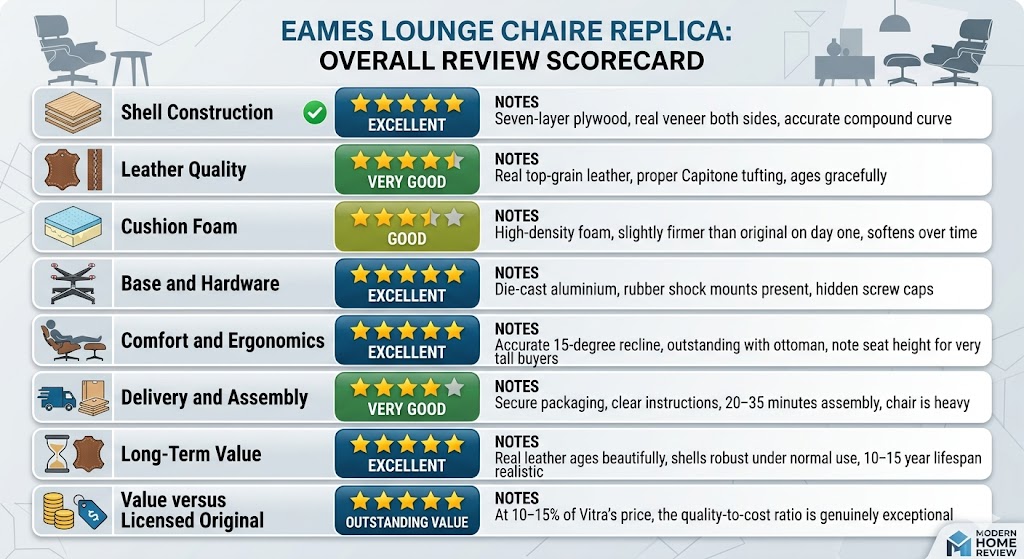
The real differences between a premium reproduction and a licensed original are: the initial softness of the foam cushions (the original is softer from day one), the leather quality at the very top end (Vitra uses exceptional hides selected from a very small number of suppliers), and the provenance — the licensed original carries documentation, heritage, and collector value that a reproduction does not.
Everything else — the silhouette, the shell construction, the base, the ergonomics, the daily experience of sitting in a beautiful chair — a quality reproduction delivers with remarkable closeness. Our full comparison is in our post: Eames Lounge Chair Replica vs Original Herman Miller.
For most European design lovers — people who care about quality and want genuine materials, not a licensed certificate — a premium reproduction is an intelligent, honest choice. Explore the full range in our Eames lounge chair replica Europe collection.
The Eames Chair in European Design Culture
The Eames lounge chair has a particular resonance in European interiors that is worth understanding. Mid-century modern design — the movement within which the chair sits — has deep roots in European modernism: the Bauhaus in Germany, Scandinavian functionalism, Italian rationalism. The Eames lounge chair arrived in Europe as an American expression of ideas that Europeans already understood and valued. It was recognised immediately.
Vitra, the Swiss company that holds the European licence, has been manufacturing the chair in Europe since the 1950s. Their facility in Weil am Rhein in Germany — a campus of buildings by Zaha Hadid, Frank Gehry, and other significant architects — is as much a statement about design culture as it is a furniture factory. The Eames lounge chair is central to their heritage and to their identity.
Across the EU, from Amsterdam canal houses to Parisian haussmannien apartments, from German Altbau flats to Portuguese farmhouses, the Eames lounge chair is one of the few pieces of furniture that integrates naturally into virtually every interior style. Its visual lightness, its warm materials, and its association with considered taste make it universally at home. For styling inspiration, see our complete guide on how to style an Eames lounge chair. For country-specific options, explore our Eames lounge chair replicas across Europe.
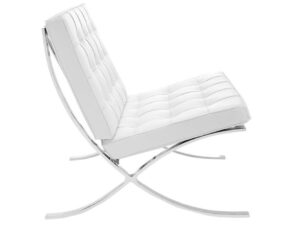
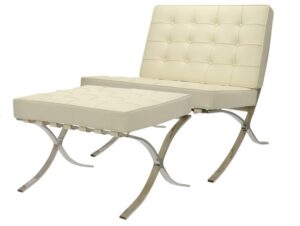
If you appreciate the intersection of classic design and modernist sensibility, you may also enjoy exploring another mid-century icon: the Barcelona chair, designed by Ludwig Mies van der Rohe — another piece that speaks the same visual language of refined simplicity.
FAQ: Common Questions Answered
What is so special about the Eames chair?
The Eames lounge chair is special for several reasons that reinforce each other. It was the first chair to combine genuine comfort with genuinely beautiful modernist design — not one at the expense of the other, but both completely. Its engineering innovations — the seven-layer moulded plywood shells, the rubber shock mounts between shell sections, the 15-degree fixed recline, and the die-cast aluminium base — were unprecedented in 1956 and remain benchmarks today. It entered the permanent collections of MoMA and the Art Institute of Chicago. And it has been in continuous production for nearly seventy years without a single significant redesign. Each of these things on its own would be notable. Together, they explain why the Eames lounge chair is considered one of the greatest furniture designs in history.
Who designed the Eames lounge chair?
The Eames lounge chair was designed by Charles and Ray Eames — a husband-and-wife design team who worked together from the early 1940s until their deaths in 1978 and 1988 respectively. The chair was produced in partnership with Herman Miller, the American furniture company that has manufactured the licensed original for the US market since its debut in 1956. In Europe, the licensed version is produced by Vitra.
When was the Eames lounge chair designed?
The Eames lounge chair was designed in 1956 and debuted on national American television on 1st January 1956 on NBC’s Home show. It has been in continuous production since that date — making it one of the longest-running furniture designs in modern history. The chair and ottoman are officially designated as models 670 and 671 in the Herman Miller catalogue.
Is the Eames lounge chair comfortable?
Yes — the Eames lounge chair is one of the most comfortable chairs ever designed. The 15-degree fixed recline distributes body weight away from the lower spine and across the back of the seat, allowing extended sitting without the fatigue that most chairs produce. The three-section plywood shell flexes slightly with body movement, and the rubber shock mounts between sections absorb dynamic load. Used with the ottoman — which extends the support from the lower back to the heels — the chair creates what Charles Eames described as “a special refuge from the strains of modern living.”
Can you sleep in an Eames lounge chair?
Many people do. The 15-degree recline and the ottoman together create a position that is remarkably close to a full recline for average-height adults. The chair is not designed specifically for sleeping, but it is comfortable enough that drifting off is a genuinely common experience — particularly after the leather and foam have broken in over the first few months of use.
What is the difference between an Eames chair and an Eames lounge chair?
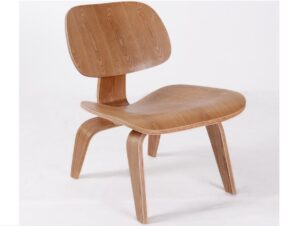
“Eames chair” is an informal term that can refer to any of the numerous chair designs produced by Charles and Ray Eames throughout their career — the DSW dining chair, the LCW plywood chair, the fibreglass armchairs, the Aluminium Group office chairs, and many others. “Eames lounge chair” refers specifically to the 1956 lounge and ottoman set (models 670 and 671) — the three-shell plywood and leather design that is the most famous single piece in the Eames portfolio and, arguably, in all of twentieth-century furniture design.
Is it worth buying an Eames lounge chair replica?
Yes — if you choose a premium reproduction from a seller who is transparent about materials and construction. A quality Eames-inspired reproduction uses genuine seven-layer moulded plywood, real leather upholstery, rubber shock mounts, and a die-cast aluminium base. At a fraction of the Vitra original’s price, it delivers the iconic silhouette, the ergonomic benefits, and the daily beauty of owning this design. Our full honest assessment is in our Eames lounge chair replica review. For current pricing and options, see our best Eames replicas under €800 with EU delivery guide.
How much does an Eames lounge chair cost in Europe?
The licensed original from Vitra — the only authorised manufacturer in Europe — starts at approximately €6,500 and can exceed €9,000 for premium leather options. Premium Eames-inspired reproductions from our collection are available from €619 to €995, including the matching ottoman, with EU delivery on every order.
Explore Further
The Eames lounge chair has inspired more writing, more discussion, and more honest admiration than almost any other piece of furniture in history. If this guide has sparked your interest — whether you are buying your first Eames-inspired chair or simply deepening your knowledge of mid-century modern design — here are the best places to continue:
- How to style an Eames lounge chair — our complete room-by-room styling guide
- Eames lounge chair replica review — our detailed honest assessment of premium reproductions
- Replica vs original Herman Miller — the full honest comparison
- Browse our Eames lounge chair replica collection — all current options with EU delivery
The Eames lounge chair is not the most expensive chair in the world. It is not the rarest, or the most technically complex. What it is, is the most completely right. Every dimension considered. Every material chosen with intent. Every detail in service of a single clear purpose — to give the person sitting in it exactly the experience of unhurried, beautiful comfort that Charles and Ray Eames wanted for anyone who sat in their chair.
Nearly seventy years later, it still does exactly that.